Posts

Showing posts with the label Characters

MBTI For Authors: 16 Personality Types To Deepen Characters
Image
The Myers-Briggs Type Indicator, or MBTI for short, is currently one of the most well known personality tests in the world. Whether you think it's accurate or not, it's undeniably an incredible tool for crafting characters.  What is MBTI, exactly? It uses 16 base personalities given in a four letter code. This code unlocks a character's personality, giving their strengths and weaknesses. But the real core of MBTI is to illustrate how a character thinks and interacts with their world.  A character's MBTI can be used to give a general idea of all sorts of things. Their kind of humour, what type of job they'd choose, who they get along with and who they're worst enemies with. It gives an idea of what a character would value and how they would react to things. But MBTI does not a character make. It's simply a tool, the same way the three act structure by itself a plot. It also isn't one size fits all. There's so many factors that go into who  a character...
#WQT: 5 Ingredients in Character Arcs

Image
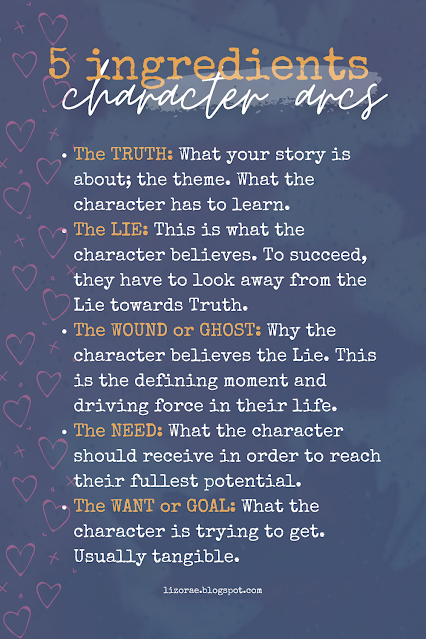
Transcript -  5 Ingredients in Character Arcs   The TRUTH: What your story is about; the theme. What the character has to learn. The LIE: This is what the character believes. To succeed, they have to look away from the Lie towards Truth. The WOUND or GHOST: Why the character believes the Lie. This is the defining moment and driving force in their life. The NEED: What the character should receive in order to reach their fullest potential. The WANT or GOAL: What the character is trying to get. Usually tangible.

#WQT: 6 Mistakes In Middle Grade Fiction

Image
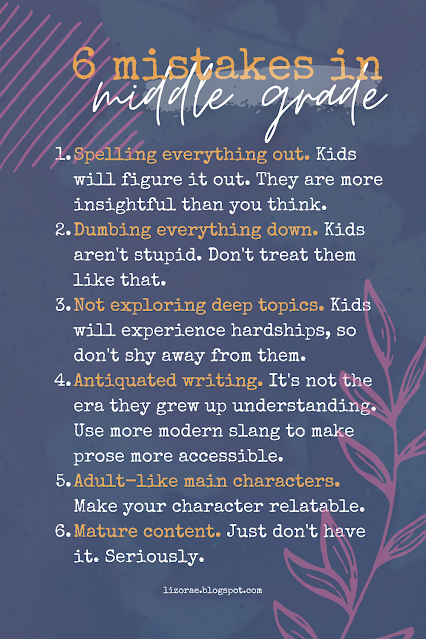
Transcript -  6 Mistakes in Middle Grade Spelling everything out. Kids will figure it out. They are more insightful than you think. Dumbing everything down. Kids aren't stupid. Don't treat them like that. Not exploring deep topics. Kids will experience hardships, so don't shy away from them. Antiquated writing. It's not the era they grew up understanding. Use more modern slang to make prose more accessible. Adult-like main characters. Make your character relatable. Mature content. Just don't have it. Seriously. 

Should Characters Be Likeable?

Image
People are always hyping up likeable characters. You'll see lists on how to make a character more likeable. How to encourage readers to adore your characters. How to let readers root for your characters.  But is making your character likeable important? Is it really as necessary as it seems?  Let's get to!  What is likeability?  The first thing you need to know is what  likeability is. Google defines it as: "pleasant, friendly, easy to like." It's true, but broad. When it comes to books, who does the character need to be pleasant and friendly to? Who needs to easily like them -- the characters or the readers?  Here's the most common criterias. These are all valid ways of choosing likeability, but I'll be judging them on how necessary they are to a reader's experience.  The readers should like them in real life.  Importance Rating: Low For a character to be likeable in this way, the reader wouldn't mind going out of hot chocolate and cake with t...

How To Character Chemistry: What it is, why it's important, 3 step method, and 2 favourite tools!

Image
Music. Curtain. Lights.  Fancy Dude: Oh, the fire in my bosom, the beating in my chest, the pan to my cakes. Scarf Girl: What is it, my love? Fancy Dude: I've been thinking about what I'm about to ask you long and hard. I have debated and quarrelled with the inner beings of our selves for years on end. *faraway look* Scarf Girl: Yes, my love? Fancy Dude: *kneels* Will you eat fried chicken with me? *applause* What was that? Only an example of character chemistry! (Albeit, not a great one.) That's right, folks. It's the long promised post on character chemistry. I've been talking about this since December, so it's about time. Let's get to! What's character chemistry anyway?  Character chemistry is the interaction between characters. It doesn't matter whether the relationship between them is platonic or romantic, nor how many characters are interacting. It happens whenever there is interaction. Between lovers, coworkers, family, friends, pets, etc. Y...

4 Lessons From Keeper Of The Lost Cities

Image
Keeper of the Lost Cities  is a MG fantasy series by Shannon Messenger. It's currently 8.5 books long and it gets so much hype. With one more book on the way, what can we look forward to? Despite all its hype, there's a lot  that has been complained about. And most of it is justified.  I've been with this series since the release of Neverseen , Book 4. While I enjoyed it at first, the more I read it, the less I enjoy it. I feel like the series began with so much potential, but missed the mark by a long shot.  Here's the four biggest problems we can take away from this series. Let's get to!    1. Special snowflake and cardboard cutouts  Our main character, Sophie Foster, is a special snowflake. She's the specialest of special snowflakes. First, what does it mean?  To be a special snowflake means that the character is treated differently, generally worshipped, because of their supposedly amazing qualities. Here's a few common traits: The world re...

5 Behaviours To STOP ROMANTICISING In Fiction

Image
Fiction impacts lives. You can't call something "just a story" because it isn't. Stories have messages, intentional or unintentional, and the readers will be affected. Sometimes, it's obvious. Sometimes, it's not so obvious.  When you're writing something, it's important to make sure you're intentional about your content. While it's okay to write from a perspective you don't agree with, you need to make sure you're framing it with intent.  The following topics on this list are objectively  bad. I'm not saying never ever write a story that has this in it, because that's wrong. Everything here has a place in fiction. What I am saying is that you should not romanticise them.  I have seen them many, many times in fiction. It's horrifying how some of them are portrayed to be good for you. Like you should wish to go through it.  Yeah nah, mate. It's painful. You don't want to experience any of these, and you don't want...

3 Lessons From The Boy And The Spy

Image
The Boy and the Spy  by Felice Arena is a MG historical fiction set during one of the World Wars. I can't remember since it's been a while since I read it. (Edit: WW2, thank you Goodreads reviews.) I try to keep the  Lessons From The Media   positive, even when noting the weaker aspect. Unfortunately, out of my February reads,  The Boy and the Spy  is one of two books I can formulate a post on. I happen to dislike this one slightly less than the other one, so here's the three main things that threw me off.  Disclaimer: this is more of a rant than an informative post. Apologies in advance.  Let's get to!    1. Clumsy prose.  Simple prose has a certain charm to it. Take The Travelling Cat Chronicles  for example. It's another February read I will recommend to anyone who wants a bittersweet, slow read. The prose is simple but still captures the reader's attention. It helps that Nana, the narrator, has a  personality-filled ...

6.5 Lessons From The WHISPER DUOLOGY

Image
The Whisper  duology , comprising of Whisper  and Weapon , is by Australian author Lynette Noni . If you guys read last week's post , you'll remember her from the YA section.  I have been most fortunate to skip the tense waiting between books and binged the whole series within a week. While I don't think it beats her Medoran Chronicles , it's still an enjoyable read. It's short, so it doesn't take up much time if you have other things to do. For those who haven't read it, it's a dystopian story about Jane Doe. Jane is locked up in a secret government agency facility called Lengard, a place that is, to say the least, unpleasant. She hasn't spoken in two years.  Without further chit-chat, here's 6.5 lessons from the  Whisper  duology .  Let's get to!    1. Keep consistent characterisation  Authors love to talk about how they developed their characters. Oh, I used 67 different questionnaires , one might say. Or, I used every major person...